

A tattoo gun is the common name many people use for a tattoo machine. It is the handheld device a tattoo artist uses to move needles and place tattoo ink into the skin. In professional tattoo studios, the term tattoo machine is more commonly used.
Modern tattoo machines come in several forms. The most common include coil machines, rotary machines, and pen-style machines. They can look and feel very different, but they all have the same basic purpose: controlling needle movement so an artist can create permanent artwork.
If you are researching a tattoo gun for general knowledge, tattoo equipment, or a future career in tattooing, this guide explains the main types, parts, uses, differences, safety considerations, and important features to understand.
What Is a Tattoo Gun?
A tattoo gun is a handheld tattooing device that rapidly moves a needle or needle grouping up and down. The needle carries pigment into the skin to create a permanent tattoo.
The phrase “tattoo gun” is common in everyday searches, but professional artists generally call the device a tattoo machine. The word “gun” can make the tool sound as though it shoots ink into the skin, while the actual mechanism is based on controlled needle movement.
Tattoo machines can be powered by electromagnetic coils, electric motors, or other mechanisms. The exact construction depends on the type of machine.
Tattoo Gun vs. Tattoo Machine
In most everyday contexts, tattoo gun and tattoo machine refer to the same basic piece of equipment.
The main difference is terminology. Tattoo machine is the preferred professional term because it more accurately describes the precision equipment used by tattoo artists.
| Term | Meaning |
| Tattoo gun | Common casual/search term |
| Tattoo machine | Preferred professional term |
| Tattoo pen | Pen-shaped type of rotary machine |
| Coil machine | Traditional electromagnetic machine |
| Rotary machine | Motor-driven tattoo machine |
So if you search for a “tattoo gun,” you will usually find products and information listed as tattoo machines.
How Does a Tattoo Gun Work?

A tattoo machine controls the movement of a needle. The needle moves rapidly and deposits pigment into the dermis, the deeper layer of skin where tattoo ink becomes relatively permanent.
The exact mechanism depends on the machine.
A coil machine uses electromagnetic coils to move an armature bar and needle.
A rotary machine uses a motor and mechanical drive system to move the needle.
A pen-style machine places a rotary mechanism inside a pen-shaped body, giving the artist a grip that resembles a writing instrument.
The artist controls the machine while working with an appropriate needle configuration and tattoo ink.
Main Types of Tattoo Guns
There are several machine designs, but coil, rotary, pen-style, and pneumatic systems are commonly discussed in tattoo equipment guides.
1. Coil Tattoo Gun
Coil machines are the traditional type many people picture when they hear the words tattoo machine.
They use electromagnetic coils to move the needle. They are known for their distinctive buzzing sound and can be adjusted by experienced artists for different tattooing tasks.
Coil machines are often associated with:
- Bold linework
- Traditional tattooing
- Color packing
- Strong needle response
- Custom tuning
- Classic tattoo setups
They can be heavier and more mechanically complex than many modern rotary machines.
2. Rotary Tattoo Gun
Rotary machines use a motor to move the needle. They generally produce less vibration and noise than traditional coil machines.
Many artists like rotary machines because they can be versatile and comfortable during longer sessions. They are used for linework, shading, color work, and other tattoo techniques.
Common benefits include:
- Smooth operation
- Lower vibration
- Quieter performance
- Versatility
- Ergonomic designs
- Compatibility with cartridge systems
3. Pen-Style Tattoo Gun
A pen-style machine is a rotary tattoo machine designed in the shape of a pen.
The shape can provide a familiar grip and may make the machine comfortable for artists who prefer a lightweight setup. Many current pen-style machines are designed for cartridge needles, and wireless versions are widely available.
Pen machines are commonly used for:
- Fine-line tattoos
- Realistic tattoos
- Shading
- Color work
- Blackwork
- General tattooing
4. Pneumatic Tattoo Machine
Pneumatic tattoo machines use compressed air rather than a conventional electric motor to drive the needle.
They are less common than coil and rotary machines but represent another approach to tattoo machine design.
Parts of a Tattoo Gun
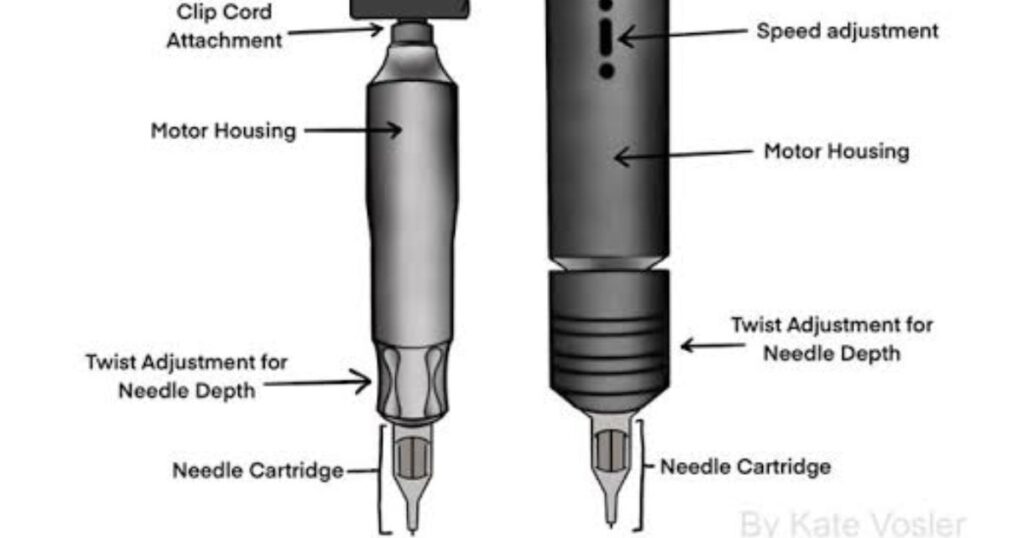
The exact parts depend on the machine type. A traditional coil machine can have more mechanical components than a modern pen-style rotary.
Common components include:
- Needle or cartridge
- Grip
- Tube or cartridge housing
- Needle bar
- Motor or coil system
- Armature bar on coil machines
- Springs on coil machines
- Frame
- Power connection
- Battery on wireless models
- Power supply for wired machines
Each component contributes to the machine’s movement, balance, control, or connection to the power source.
Tattoo Gun Needle Types
The needle configuration has a major effect on the tattooing result.
Tattoo needles can be grouped into different configurations for purposes such as lining, shading, and color packing. Liner needles are arranged to create controlled lines, while shader and magnum configurations cover larger areas more gradually.
Common categories include:
- Round liners
- Round shaders
- Magnums
- Curved magnums
- Flat needles
- Cartridge configurations
The correct needle should be selected according to the artist’s technique, design, machine, and training.
Tattoo Gun for Lining
Lining is the process of creating the main outlines of a tattoo.
Artists often use configurations designed for controlled, consistent lines. Machine behavior, needle grouping, hand movement, and technique all affect the final result.
A good line is not created simply by buying a particular machine. Artist skill and proper technique are equally important.
Tattoo Gun for Shading
Shading adds depth, gradients, and tonal variation to a tattoo.
Rotary machines are often popular for shading because of their smooth motor-driven movement, although experienced artists can use different machine types depending on their preferred technique.
The needle configuration also plays an important role. Shader and magnum groupings can cover more skin than small liner configurations.
Tattoo Gun for Color Packing
Color packing involves placing enough pigment into an area to create solid, even color.
Machine choice, needle configuration, ink, skin condition, and artist technique all affect the result.
Traditional coil machines have long been used for color packing, while modern rotary machines are also widely used for the task.
Wired vs. Wireless Tattoo Guns

Tattoo machines can be connected to an external power supply or powered by a rechargeable battery.
Wired Tattoo Machine
A wired machine connects to a power supply. This setup can provide consistent power but leaves a cable running between the machine and power source.
Wireless Tattoo Machine
A wireless machine uses a rechargeable battery attached to or integrated with the machine.
Wireless designs can give artists more freedom of movement and reduce cable clutter. Pen-style wireless machines are now common in modern tattoo studios.
| Feature | Wired | Wireless |
| Power | External supply | Rechargeable battery |
| Cable | Yes | No machine cable |
| Mobility | Lower | Higher |
| Setup | Requires power supply | More portable |
| Charging | Not applicable | Required |
Neither option is automatically better. The right choice depends on the artist’s workflow and preferences.
Tattoo Gun Stroke Length
Stroke length refers to the distance the needle mechanism travels during its movement.
Different stroke lengths can suit different techniques. Shorter strokes may be preferred for certain detailed work, while longer strokes can be useful for other applications such as shading or color packing.
There is no single stroke length that is perfect for every tattoo. Machine type, needle configuration, technique, skin, and artist preference all matter.
Beginners should learn machine specifications from qualified tattoo educators rather than choosing settings based only on a number found online.
What Makes a Good Tattoo Gun?
A good tattoo machine should be reliable, appropriately balanced, and suitable for the artist’s technique.
Important factors include:
- Build quality
- Motor performance
- Weight
- Balance
- Ergonomics
- Stroke options
- Battery performance
- Needle compatibility
- Manufacturer support
- Ease of maintenance
The most expensive machine is not automatically the best choice. A machine should match the artist’s skill level and intended work.
Tattoo Gun for Beginners
Beginners should focus on learning tattoo safety and technique before worrying about expensive equipment.
A beginner-friendly machine should be:
- Comfortable to hold
- Reliable
- Easy to understand
- Compatible with appropriate supplies
- Suitable for supervised practice
- Supported by clear manufacturer information
Tattooing involves breaking the skin, so it should not be treated like a normal drawing hobby. Proper training, hygiene, sterilization, and local regulations are essential.
Practicing on synthetic skin can help a learner become familiar with machine handling before working on a person.
Tattoo Gun Safety
Safety is one of the most important parts of tattooing.
Professional tattoo equipment must be handled in a way that prevents cross-contamination. Needles and other single-use components should be appropriately sterile and changed between clients. Machines and cords that cannot be sterilized must be protected with suitable barriers and disinfected according to applicable procedures.
Important safety principles include:
- Use appropriate sterile, single-use needles.
- Use fresh disposable cartridges where applicable.
- Wear suitable gloves.
- Use barriers on equipment where required.
- Clean and disinfect reusable equipment correctly.
- Follow local health regulations.
- Dispose of contaminated sharps properly.
- Never reuse disposable needles between clients.
- Keep the workspace clean and organized.
Can You Use a Tattoo Gun at Home?
Using a tattoo machine at home can create serious hygiene and injury risks if the person is untrained or lacks proper sterilization procedures.
Tattooing breaks the skin. Poor hygiene can increase the risk of infection and bloodborne pathogen transmission.
For someone learning tattooing, professional training and supervised practice are much safer than experimenting on another person.
If you are getting a tattoo, choose a reputable professional studio that follows appropriate infection-control procedures.
Tattoo Gun Cleaning and Maintenance
A tattoo machine needs proper maintenance, but cleaning procedures depend on its design.
Equipment that cannot be sterilized in an autoclave may require protective barriers and approved cleaning and disinfection between clients. Disposable components should be discarded appropriately after use.
Always follow the manufacturer’s maintenance instructions for the specific machine.
Do not assume that wiping a machine with an ordinary household cleaner makes it safe for professional tattooing.
How Much Does a Tattoo Gun Cost?
Tattoo machine prices vary widely depending on the manufacturer, mechanism, materials, features, and whether the machine is intended for professional use.
Basic machines can be relatively inexpensive, while professional machines can cost significantly more.
When comparing prices, consider the entire setup rather than only the machine. A professional setup may also require appropriate needles, cartridges, power equipment, grips, barriers, cleaning supplies, and other studio equipment.
Tattoo Gun vs. Tattoo Pen
A tattoo pen is not a completely different category of tattooing technology. Most pen-style machines use rotary mechanisms.
The main difference is the shape and ergonomics.
| Feature | Traditional Machine | Pen-Style Machine |
| Shape | Varies | Pen-shaped |
| Mechanism | Coil or rotary | Usually rotary |
| Grip | Traditional grip styles | Writing-like grip |
| Weight | Varies | Often lightweight |
| Cartridges | Depends on machine | Common |
| Wireless options | Available | Very common |
Coil vs. Rotary Tattoo Gun
| Feature | Coil | Rotary |
| Mechanism | Electromagnetic coils | Motor |
| Sound | Louder buzz | Generally quieter |
| Vibration | More noticeable | Usually lower |
| Weight | Often heavier | Often lighter |
| Tuning | More mechanical adjustment | Usually simpler |
| Versatility | Depends on machine | Often highly versatile |
| Common use | Traditional work and strong lines | Lines, shading, color, general work |
Both systems can produce excellent tattoos when used by skilled artists.
Tattoo Gun for Fine-Line Tattoos
Fine-line tattooing requires control and careful needle selection.
Pen-style rotary machines are commonly used for fine-line work because they can provide a smooth, controlled experience. However, the machine alone does not guarantee fine lines.
The artist’s hand speed, needle configuration, skin knowledge, and technique all contribute to the final result.
Tattoo Gun for Realistic Tattoos

Realistic tattoos require careful shading, gradients, texture, and detail.
Rotary machines are often used for realism because of their smooth operation and versatility. Artists may use multiple needle configurations during a single tattoo.
Realism is highly technique-dependent, so looking at an artist’s healed portfolio is more useful than choosing a machine based only on its specifications.
Tattoo Gun for Traditional Tattoos
Traditional tattoos often use bold outlines and solid color.
Coil machines have a long association with traditional tattooing, although many contemporary artists also use rotary machines.
The important factor is not the machine’s appearance but whether the artist can achieve the desired line quality, saturation, and consistency.
Tattoo Gun for Blackwork
Blackwork tattoos use black ink to create bold shapes, patterns, and artwork.
A rotary or coil machine may be used depending on the artist’s preferred approach. Large black areas require appropriate technique to achieve even saturation while managing skin trauma.
Tattoo Gun History
The development of electric tattoo machines is connected to the late nineteenth century.
Thomas Edison patented an electric pen in 1876. Samuel O’Reilly later adapted the concept for tattooing, receiving a patent for an electric tattoo machine in 1891.
Since then, tattoo machines have evolved significantly. Traditional coil designs remain important, while rotary and wireless pen-style machines have become increasingly common.
Modern equipment focuses heavily on ergonomics, consistency, portability, and compatibility with cartridge systems.
How to Choose a Tattoo Gun
Choosing a tattoo machine depends on what you plan to do with it.
Consider these factors:
Machine Type
Decide whether a coil, rotary, or pen-style machine fits your goals.
Weight
A heavy machine may feel different during long sessions than a lightweight model.
Balance
Good balance can make a machine more comfortable and easier to control.
Stroke
Consider the types of tattoo work you plan to learn and choose a machine with suitable stroke characteristics.
Power
Check whether you prefer a wired power supply or wireless battery setup.
Needle Compatibility
Make sure the machine supports the needle or cartridge system you plan to use.
Training
Your education and technique matter more than buying the most expensive equipment.
Common Tattoo Gun Mistakes
New tattoo artists can make mistakes when choosing or using tattoo equipment.
Common problems include:
- Choosing a machine only because it looks attractive.
- Buying extremely cheap equipment without researching quality.
- Ignoring hygiene requirements.
- Practicing directly on people without proper training.
- Using inappropriate or reused needles.
- Focusing on machine settings instead of developing technique.
- Ignoring manufacturer instructions.
- Failing to protect equipment from contamination.
Learning the fundamentals first can prevent many avoidable problems.
Tattoo Gun vs. Tattoo Needle
These are two different parts of the tattooing setup.
The tattoo machine controls the needle’s movement.
The needle is the component that enters the skin and carries or deposits pigment.
A machine can work with different needle configurations depending on its design. The machine and needle must be compatible and used correctly.
Frequently Asked Questions
Is a tattoo gun the same as a tattoo machine?
Yes. “Tattoo gun” is a common casual term for a tattoo machine. Professional artists generally prefer the term tattoo machine.
What is the best tattoo gun?
There is no single best machine for everyone. The right choice depends on experience, tattoo style, machine type, ergonomics, stroke, power system, and needle compatibility.
Are tattoo guns safe?
Professional tattoo machines can be used safely when appropriate infection-control procedures, sterile supplies, training, and local health requirements are followed.
What is the difference between coil and rotary tattoo guns?
Coil machines use electromagnetic coils to move the needle, while rotary machines use a motor-driven mechanism. Rotary machines are generally quieter and have less vibration.
Are tattoo pen machines rotary?
Most modern tattoo pen machines use rotary mechanisms. Their pen-shaped design is intended to provide a familiar and ergonomic grip.
Can beginners use tattoo machines?
Beginners can learn tattooing, but they should receive proper training and practice safely, including on appropriate synthetic practice materials before tattooing people.
How does a tattoo gun put ink into the skin?
The machine repeatedly moves a needle or needle grouping into the skin, allowing pigment to be deposited in the dermis.
How long does a tattoo machine last?
A quality machine can last for years when it is maintained properly. Actual lifespan depends on construction, frequency of use, maintenance, and the specific model.
Do tattoo machines use batteries?
Some do. Wireless rotary and pen-style machines can use rechargeable batteries, while traditional wired machines connect to an external power supply.
What should I look for in a tattoo machine?
Consider build quality, weight, balance, motor performance, stroke options, power system, needle compatibility, ergonomics, and manufacturer support.
Conclusion
A tattoo gun, more accurately called a tattoo machine, is the primary tool used to create permanent tattoos. It controls the movement of needles that deposit pigment into the skin.
Coil machines represent traditional tattoo equipment, while rotary and pen-style machines offer modern alternatives with different handling characteristics. The best choice depends on the artist’s technique, experience, preferred style, and workflow.
If you are learning tattooing, remember that equipment is only one part of the craft. Proper training, hygiene, infection control, and responsible practice are essential for creating tattoos safely and professionally.